Disclosure: As an Amazon Associate, I earn from qualifying purchases. This costs you nothing extra.
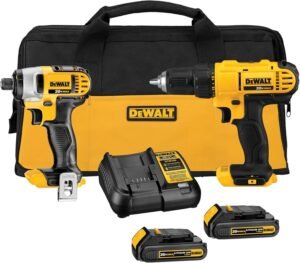
The DCK240C2 is one of the most common “first real toolset” purchases in North America, and for good reason: it bundles the two cordless tools that cover roughly 90% of household and light construction work, plus two batteries, a charger, and a bag. Here is what is actually in the box and whether it fits what you are doing.
Drill vs. impact driver: why you need both
This is the part most first-time buyers get wrong, so it is worth being clear.
The drill has a keyless chuck that accepts round and hex bits of varying sizes, and a clutch collar with numbered settings. It applies smooth, continuous rotation. Use it for drilling holes in wood, metal, drywall, and plastic; for driving screws where you need to control depth precisely; and for anything where over-tightening would split the material or strip the head.
The impact driver has a quarter-inch hex collet and no clutch. It delivers rotation plus rapid concussive blows along the axis of the screw. Use it for long screws and lag bolts, deck boards, framing, and anything where the drill would stall or twist your wrist.
The impact driver drives fasteners the drill physically cannot, and the drill does precision work the impact driver would destroy. Buying them together is why combo kits exist.
What is in the box
- 20V MAX cordless drill/driver
- 20V MAX impact driver
- Two 20V MAX lithium-ion battery packs
- Charger
- Contractor bag
Two batteries is the meaningful inclusion. One charges while the other works, and you never stop mid-job.
The battery question
Here is the thing to understand before buying: the batteries in this kit are compact packs, not the larger high-capacity ones. That is a deliberate cost decision, and it has consequences.
Compact batteries keep the tools light and well-balanced, which matters a lot when you are working overhead or in a tight cabinet. Where they run short is sustained work: driving fifty deck screws or drilling a series of large-diameter holes will drain a compact pack faster than you would like. For a weekend project this is fine. For a full day of framing, it is not.
The good news is that every 20V MAX battery fits every 20V MAX tool. If you outgrow the included packs, you can add a higher-capacity battery later without replacing anything else. That platform compatibility — the 20V MAX line covers well over a hundred tools — is arguably the strongest reason to buy into this system rather than a cheaper standalone drill.
Build quality and handling
Both tools use the same design language: rubber overmold on the grip, LED work light at the base of the chuck, belt hook, and a housing that survives being dropped off a ladder. The ergonomics are unremarkable in the best way — nothing about holding these tools calls attention to itself.
The LED lights deserve a specific mention. They are positioned to illuminate the work surface rather than cast a shadow of the chuck across it, which sounds trivial until you have used a tool that gets it wrong.
Getting the most out of it
- Match the bit to the material. Twist bits for wood and soft metal, brad-point for clean holes in wood, masonry bits for brick and concrete — and note that a standard drill/driver is not a hammer drill.
- Use the clutch. The numbered collar limits torque. Set it low for small screws in softwood and work up. This is the most-ignored feature on any drill and the reason so many projects end with a stripped screw head.
- Do not use the impact driver for everything. It is addictive because it never stalls, but it will happily snap a screw or sink a fastener straight through drywall.
- Store batteries partly charged, indoors. Lithium packs left at zero charge in a freezing garage over winter degrade fast.
Who should buy it
Good fit if: you are building a first toolkit, you do periodic home improvement and repairs, or you want to buy into a battery platform you can expand.
Look elsewhere if: you need a hammer drill for masonry, you are doing all-day professional work that demands high-capacity batteries, or you genuinely only need one tool — a standalone drill costs considerably less.
Bottom line
The DCK240C2 has stayed on best-seller lists for years because it answers the question most buyers are actually asking: what two tools should I own, and what batteries do they take? It is not the most powerful kit DeWalt sells and it is not meant to be. It is the sensible starting point, and the platform grows with you.